

[Dispatch=Lee Myung-gu] Survey results on the ethical standards of online news outlets and unethical practices, as perceived by both users and industry workers, have been released.
The survey was commissioned by the Internet Press Ethics Committee (Chairman Lee Jae-jin, hereafter IPEC) to a research team led by Professor Yoo Hong-sik of Chung-Ang University's Media and Communication Division. The survey covered 500 users and 104 workers from subscribing media outlets participating in IPEC's self-regulatory activities, conducted in March 2026. IPEC has been conducting the same research and surveys continuously since 2024.
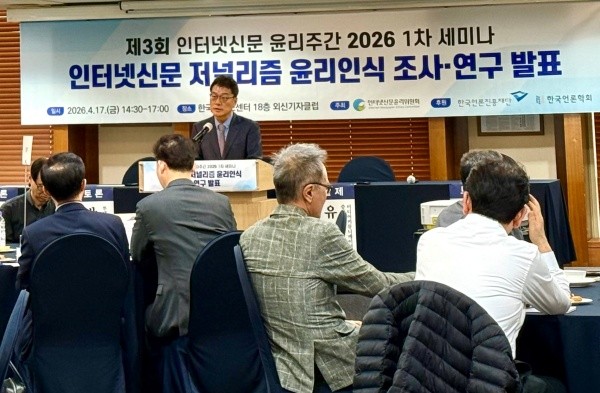
The results were presented at a seminar titled "Internet Press Journalism Ethics Awareness Survey and Research Presentation" held at the Press Center on the 17th, commemorating the "3rd Internet Press Ethics Week 2026" hosted by IPEC. Key findings are summarized as follows:
■ Online news credibility rising but still at low levels
User trust in online news outlets showed a three-year consecutive increase: 2.24 points in 2024, 2.36 points in 2025, and 2.57 points in 2026. This level is similar to the overall domestic media credibility rating of 2.60 points, though it remains below the 3-point threshold at low levels.
■ Sensationalism and conflict bias declining, yet still elevated
Online news "sensationalism" scored 3.89 points (down from 4.02 points in 2025) and "conflict bias" scored 3.86 points (down from 4.05 points in 2025), both showing year-over-year decreases and marking the lowest levels in the three-year survey period. However, with scores still in the late 3-point range, users continue to perceive high levels of sensationalism and bias in online news.
■ Users see "advertorial articles" as most serious; industry workers cite "article plagiarism"
Among unethical practices perceived by users, "reporting advertisements as news" ranked highest for the third consecutive year with 4.08 points. This was followed by "writing articles without fact-checking" (4.03 points) and "false or fabricated reporting" (3.96 points). Among industry workers, "article plagiarism" scored highest at 3.87 points, followed by "unverified reporting" (3.84 points) and "false or fabricated reporting" (3.76 points).
■ Misleading advertising emerges as biggest issue in online news ads
Regarding online news advertising, users identified "clickbait advertisements with titles unrelated to content" as the most problematic issue with 4.37 points. This was followed by "false or exaggerated advertising" (4.20 points), "advertisements obstructing article content" (4.11 points), and "advertisements confused with articles" (4.09 points).
■ Agreement on need for stronger self-regulation; positive assessment of self-discipline
Regarding the necessity of strengthening IPEC's self-regulation, users scored 3.65 points and industry workers scored 3.64 points, indicating agreement from both sides. Evaluation of current self-discipline activities showed workers scoring 4.15 points, maintaining high levels above 4 points for the second consecutive year.
■ New ethical issues emerge including AI use and advertising disclosure
Sixty-four percent of industry workers reported having experience using generative AI in article writing, with positive perception of AI articles (43.3%) exceeding negative perception (28.8%). Regarding mandatory labeling of advertorial and sponsored articles, 57.4% expressed support, while 46.1% supported mandatory disclosure of press release-based articles.
Professor Yoo Hong-sik of Chung-Ang University's Media and Communication Division, who led the survey, stated: "Online news credibility shows a gradual improvement trend, but remains at low levels overall. In particular, since unethical practices such as advertorial articles continue to be repeatedly pointed out, it is important to enhance the effectiveness of self-regulation in addressing these issues."